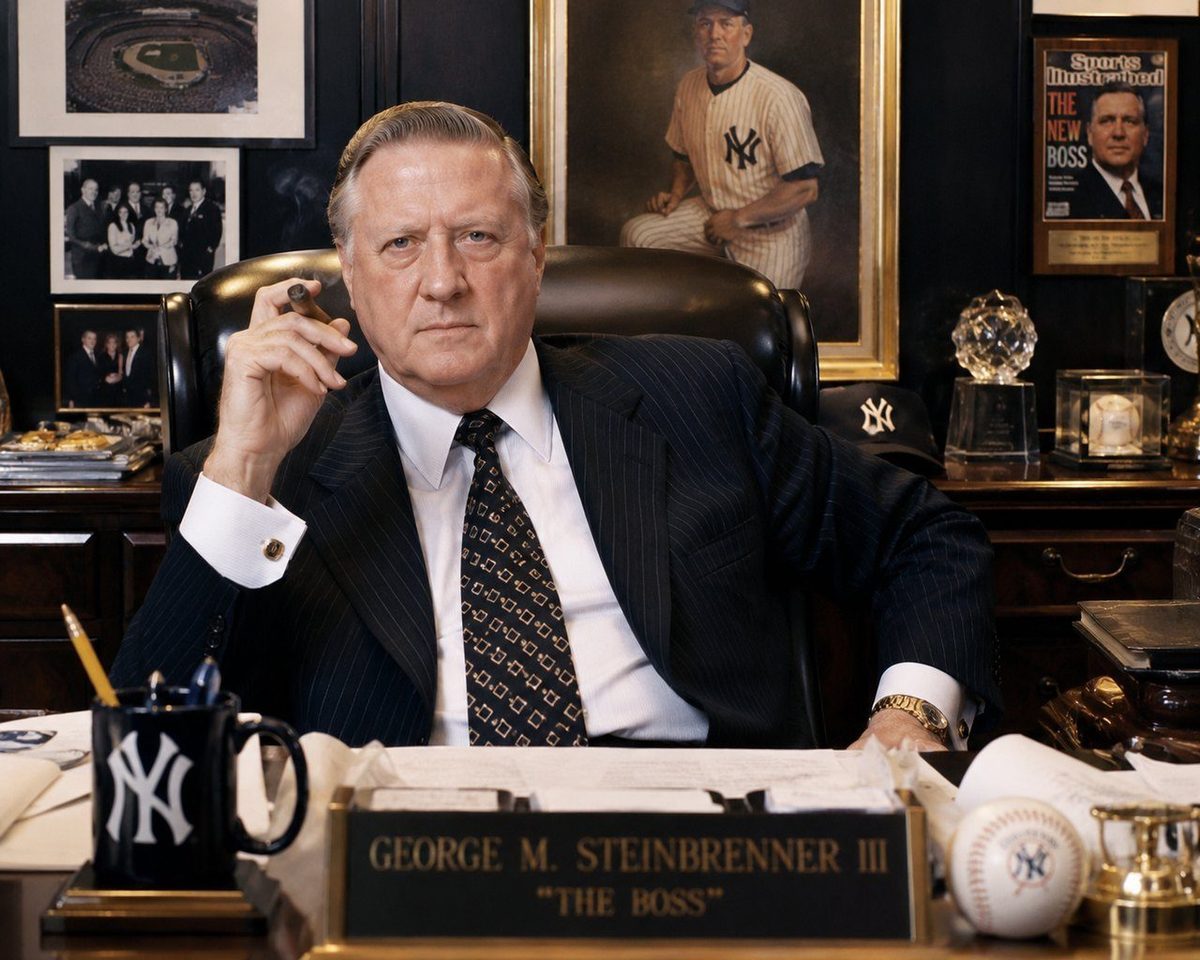
George Steinbrenner III (1930-2010) is best known for his win-at-all-costs attitude. During his 37 years with the Bronx Bombers, he won 7 World Series titles and 11 pennants. His outspokenness, his willingness to drive up salaries across the league, and his insistence on clean-cut individuals made “The Boss” a controversial figure.
In the 1973 home opener against the Cleveland Indians, George noticed that a few individuals — Thurman Munson, Bobby Murcer, and Sparky Lyle — had hair that was too long. Steinbrenner was obsessed with the military-style cut. Don Mattingly was benched for sporting a mullet and refusing to trim his hair during the 1991 season. All players, coaches, and male executives were forbidden to display any facial hair other than mustaches (except for religious reasons), and scalp hair could not be grown below the collar.
The casual sports fan believes Steinbrenner bought his World Series titles and simply paid for every good player he wanted. That narrative started after the 1980 season, when he signed Dave Winfield to a 10-year, $23 million contract, making him the highest-paid player in the game. His outspokenness showed when Winfield played poorly in the playoffs:
Where is Reggie Jackson? We need a Mr. October or a Mr. September. Winfield is Mr. May. My big guys are not coming through. The guys who are supposed to carry the team are not carrying the team. They aren’t producing.
In 1990, Steinbrenner received a lifetime ban for paying a gambler to dig up dirt on Winfield, after Winfield sued the Yankees for failing to contribute $300K to his foundation — a contract agreement. It is the reason Winfield entered the Hall of Fame as a San Diego Padre, rather than with the team that made him famous.
In 1993, George was reinstated, and the newest empire began. This time the Yankees let homegrown talent rise through the farm system rather than purchasing it. Great players such as Bernie Williams, Derek Jeter, Andy Pettitte, Jorge Posada, and Mariano Rivera came up through the system. The Yankees seemed unstoppable, winning World Series titles in 1996, 1998, 1999, and 2000.
While George was viewed at times as an evil man — for his temper and for throwing his players under the bus — he was also a generous one. He contributed to the Jimmy Fund, the Boston-based fundraiser in the fight against cancer. And he gave money to students the way parents hand out candy to trick-or-treaters.
The reality of George Steinbrenner III is that he did not buy his titles any more than the other clubs did when they won the World Series. George simply put out a solid product on the field year after year, and turned a $10 million franchise into a $1.2 billion heavyweight. It’s not his problem that he was a better owner than his peers. He wanted to make his fans — along with himself — happy.
His life was the New York Yankees, and we’ll likely never see a better sports owner in our lifetime.